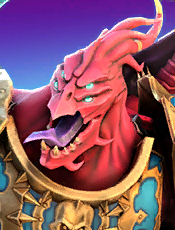
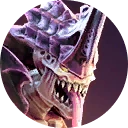
Daemon Princes of Tzeentch are potent sorcerers and monstrous warriors, terrifying in their martial might. Buoyed upon sorcerous zephyrs, they revel in hurling arcane fire from on high, reinforcing their megalomaniacal superiority over their foes.
Explore Active and Passive levels independently. Rarity and stars apply to all three abilities.
RarityMythic⌄
StarsMythic wings⌄
Mythic · Mythic wings · Active 60 · Passive 60
active ability
Aether Stride
160
Summons Z'Kar as a stationary unit in a 3 hex area on the battlefield. If he is summoned adjacent to a friendly Psyker, he immediately performs a normal attack against a target in range. When Z'Kar is defeated or leaves the battlefield via his Hunter of Souls battlefield ability, he returns as Machine of War.
Z'Kar Stats:
7830 Health
914 Damage
2088 Armour
Initial cooldown: 1 round.
Cost: 1 munition.
passive ability
Infernal Cannon
160
Targets a hex on the battlefield. Deals 3x 3262-4568 Flame Damage to all enemies that are on Fire hexes or have taken Psychic Damage this turn. Then adds Fire to the targeted hex.
Initial cooldown: 1 round.
This ability's Damage ignores all of the attacker bonuses and modifiers (including elevation), and cannot Crit.
mythic ability
Cabal of Sorcerers
Friendly Mythic Psyker characters deal +20% Damage if they are adjacent to Z'Kar or adjacent to another friendly Mythic Psyker character.
Scales with Mythic promotions · Mythic wings
Overview
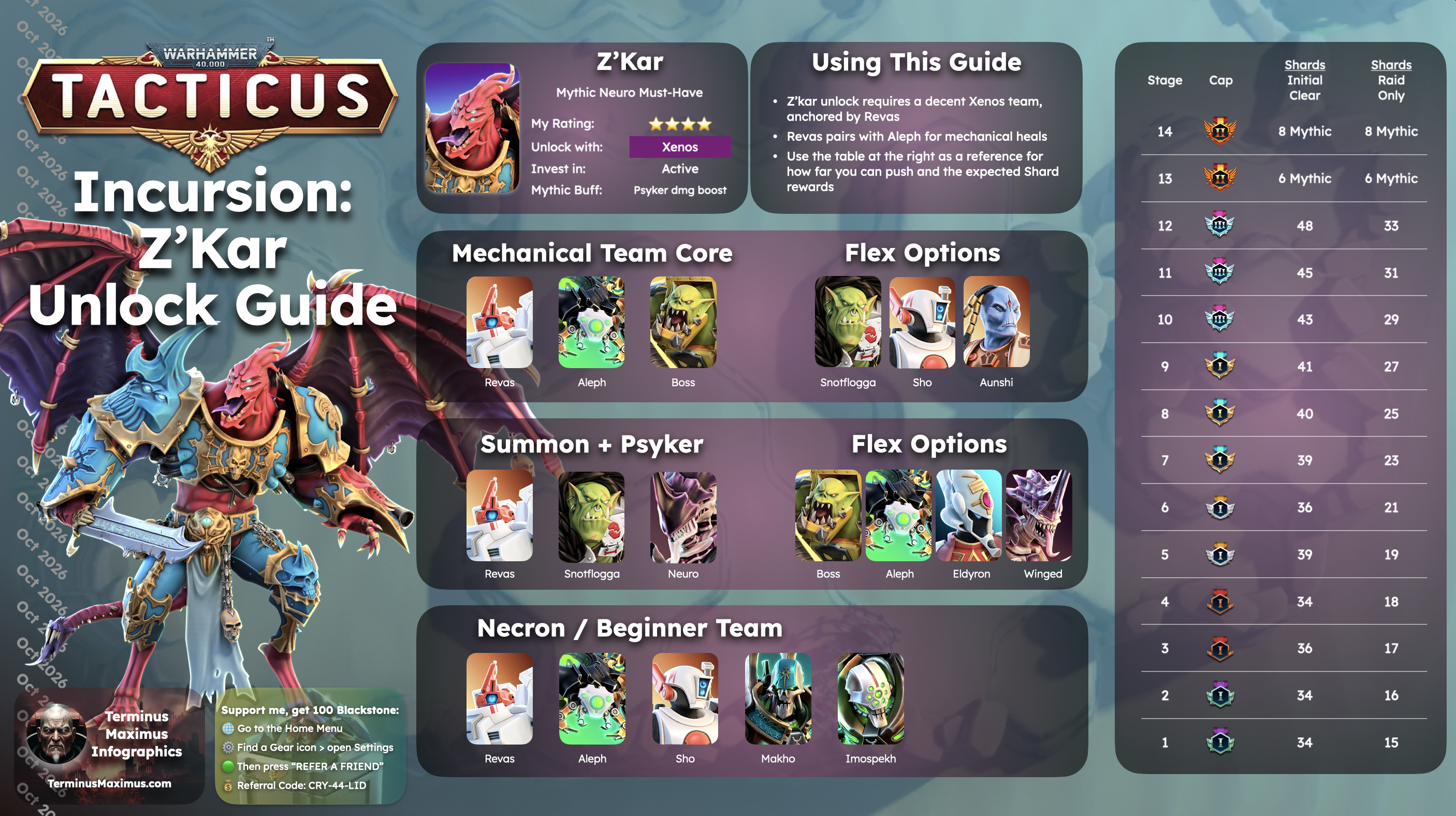
Machine: Z’Kar · Eligible alliance: Xenos
Screen the damage. Break the armour. Keep the team alive.
Start with Re’vas, Aleph-Null, and Boss Gulgortz if they are already developed. Snotflogga and Sho’syl complete the best-documented recent five. Summons protect the roster, Aleph repairs the mechanical core, and piercing or psychic damage helps against armoured Thousand Sons. Adapt the remaining slots to your account rather than treating one five as mandatory.
01
Keep a repairable core
Re’vas controls approaches, Boss creates pressure, and Aleph keeps mechanical allies fighting across several battles.
02
Bring an armour answer
Sho’syl or Neurothrope adds a different damage profile. Do not expect low-pierce basic attacks to solve every Rubric or terminator.
03
Read the map first
Fire, isolated starting hexes, bridges, and time ghosts can change a good team’s opening. Place summons with the next turn in mind.
Three Ways to Build for Z’Kar
Start with the path that fits your account, build around its core heroes, then use flex slots to adapt it.
Hero Guides: Select a hero’s name or portrait in the strategies below for stats, abilities, traits and ratings.
Add Snotflogga and Sho’syl to complete the demonstrated five. Snot supplies Grots and control; Sho supplies piercing damage while staying behind the screen.
How to play
Spend summons. Repair heroes.
Use Boss, Snotflogga, and Aleph to put disposable bodies between the enemy and your roster. Set Re’vas where suitable targets can enter overwatch. Keep Sho safe and use his damage against targets that shrug off weaker hits. Leave Aleph a safe repair opportunity before the last original enemy falls.
The Tier 14 guide includes follow-up attempts for battles 5 and 9, and reports an earlier Re’vas death. It demonstrates solutions for every numbered battle, not a flawless continuous run. Snot’s repair synergy requires his Mythic relic.
Snorri’s Tier 11 finale uses Aun’shi, Aleph, Boss, Snot, and Sho, with no Re’vas. This is a demonstrated finale alternative for an existing Aun’shi roster; it does not establish a full-route substitute.
02
Psychic / Support
Adapt to heavy armour
A Neurothrope route with flexible repair and damage support.
Aleph is the usual fourth for repairs. Boss adds summons and pressure; Eldryon is the damage-support alternative. Choose two flex characters, and change the balance only when the map and roster justify it.
How to play
Keep the screen. Change the damage source.
Use summons and Re’vas to buy Neurothrope safe attacks into armoured targets. Preserve space for Aleph to repair the mechanical frontline. Eldryon is useful when his positioning and damage support improve your attacks; avoid exposing him merely to force the buff into range.
That route skips battles 5, 9, and 14. The footage supports a flexible approach, not proof that this exact composition clears every map.
Kaiser uses Maugan Ra once, in battle 4, and Winged Prime once, in battle 10. These are situational swaps from a developed roster, not additional required investments.
03
Necron-Led Unlock
Build from campaign progress
A lower-tier example for an account with established Necrons.
Use the strongest suitable fifth already on your account. Re’vas joins the recorded battle 8 after earlier supporting characters have fallen.
How to play
Reach the unlock with the roster you have.
Let the Necron core supply movement, repair, and defensive coverage while Sho provides piercing damage. Keep Aleph alive and avoid turning an expendable fifth into a new upgrade project. Stop treating an unlock target as a demand to clear the hardest available tier.
The video stops at the unlock, before the finale. Thutmose dies in battle 5 and Hollan in battle 7. This is an account example, not a tested minimum-rank or casualty-free recipe.
Power-Up Priorities
Support the team that is actually surviving your route. Caoryn’s recent Mythic guide takes Regeneration and a Harlequin; earlier footage demonstrates single-character damage upgrades. There is no proven universal pick order.
The Tier 14 guide chooses Regeneration before battle 4 and a Harlequin before battle 8. Recovery preserves the roster; an extra body can draw fire or consume a terminator’s opening protection.
Choose Extra Hits for an attacker already getting damage through; consider Piercing when armour is stopping a low-pierce unit. Match the choice to your own damage dealer. Caoryn’s earlier route demonstrates Piercing on Boss on an alternate branch.
Prefer recovery or another protective body when losses threaten the unlock. Aleph can sustain mechanical allies, but Sho needs protection. The lower-tier example demonstrates why the fifth slot may change as a run progresses.
Compare Extra Hits, Piercing, recovery, and Harlequins
Extra Hits
Adds two hits to normal attacks. Favor a character whose basic attack is already doing useful damage. Calandis is a recorded choice in both tracks; do not assume a buff to Sho’syl also buffs every drone attack.
Piercing Ratio
Adds 20 percentage points of normal-attack piercing. Consider it when armour is the obstacle, especially for a low-pierce attacker; more hits alone may still leave each hit doing little damage.
Regeneration
Restores 13% health when a deployed character enters the next battle. It supports an intact roster between fights, but does not replace an immediate repair or revive a fallen character.
Restoration
Fully restores three selected characters. Take the recovery your current roster needs; the recorded PBC alternate branch uses it instead of a damage upgrade.
Harlequin
Available in both Xenos tracks. The extra body can absorb an attack or spend the first hit into terminator protection. Both the Z’Kar Mythic guide and the PBC Common routes demonstrate this option.
Mythic relics
Snotflogga’s Supa-Cybork Body enables repair-based sustain at Mythic. It does not grant the Mechanical trait. Relic effects are disabled below Mythic, so do not build a lower-tier healing plan around them.
Rules for Success
Repair before the last kill
Use a safe enemy to buy a repair turn before ending the battle. Aleph sustains mechanical allies; organic shooters such as Sho’syl and Calandis need their own protection or healing.
Make room for summons
Check the available hexes before calling drones, scarabs, Boyz, or Grots. A summon that cannot spawn or reach the enemy cannot protect your roster.
Set up overwatch kills
Re’vas needs kills to keep her overwatch going. Place her where suitable enemies will enter range; a heavily protected first target can stop the chain.
Prepare for the whole run
Health and losses carry forward. Finish upgrades before starting, keep your strongest characters alive, and choose your route and power-ups together. Active abilities are available again in each battle.
Open the armour, then commit
Spend a cheaper attack into terminator protection before your valuable shot. Occupy time-ghost hexes to remove the revival opportunity. Sho’s piercing and Neurothrope’s psychic damage are useful options against heavy armour.
Respect fire and psychic setup
Watch enemy psychic attacks and fire that enable Z’Kar’s cannon. Flying does not make a character immune to burning hexes. Check the end position of a move, not just whether the unit can cross the terrain.
Stage-Specific Tips
Use these notes alongside Caoryn’s Tier 14 / Mythic II chapters. Battles 5, 8, 9, and 15 are expanded because their openings deserve particular attention. Select any battle for its tip and video link.
The source uses Re’vas, Aleph, Boss, Snot, and Sho. Battles 5 and 9 contain inserted follow-up attempts. Enemy strength, your power-ups, and your chosen branch can change the result; copy the positioning idea only after checking your own map.
Battle 1Rubrics: repair before the last kill
Use summons to hold space while the damage dealers work. Low-pierce attacks can underperform badly; do not judge the whole team by Aleph’s basic attack.
Withdraw into a compact screen and use summons to block access. Try to draw Yazaghor into overwatch only when Re’vas can survive the setup. The creator reports an earlier Re’vas death; this follow-up still needs repairs.
Use a cheaper attack to consume the terminator’s opening protection before committing stronger attacks. Occupy a time-ghost hex to remove the revival opportunity. These Thousand Sons enemies are distinct from PBC’s Black Legion deep-strikers.
Put a flyer on the isolated northern hex so it can escape toward the main group. Pressure Abraxas, protect the approach with summons, and save overwatch if only protected terminators can trigger it.
Remove enemy psychic threats and avoid fire that enables Z’Kar’s cannon. Overkill Pink Horrors when feasible to prevent splits. Check the path across bridges before using Waaagh, and occupy time-ghost hexes when relevant.
Re’vas catches both characters early in this recording. Check enemy order, overwatch reach, and summon occupancy before copying the opening. Prioritize Thaumachus when practical; Caoryn’s earlier Tier 10 example also uses scarabs to absorb Ahriman’s attack.
Shard rewards verified against game version 1.44.88. Initial clears show the maximum from one route with all star rewards; your chosen branches can give fewer shards. Ranks are shown through Adamantine II.
Use this table for current rewards; the infographic above retains its original reward figures.
Tier
Rank cap
ShardsInitial clear
ShardsRaid only
14
8Mythic+ up to 19 regular
8Mythic
13
6Mythic+ up to 18 regular
6Mythic
12
48
33
11
45
31
10
43
29
9
41
27
8
40
25
7
39
23
6
37
21
5
39
19
4
36
18
3
36
17
2
34
16
1
34
15
Why We Recommend These Teams
5 creators · 15 uploads
The October 2026 review combines 15 Z’Kar uploads from five creators, including Caoryn’s recent Mythic II guide. Creator agreement is counted by creator, not by number of clips. Written Reddit and Discord reports supply additional flex ideas below.
Aleph appears somewhere in all five creators’ footage. Re’vas and Boss each appear in four of the five, with different exceptions; neither is mandatory in every demonstrated team.
Snotflogga is the strongest recurring fourth for the mechanical core. Sho is the fifth in the most recent complete set of numbered-stage solutions.
Neurothrope has a substantial Mythic route demonstration. Necron-led unlock footage and an Aun’shi finale show why roster-specific alternatives belong in the guide.
Caoryn
2 uploads
Tier 10 · Tier 14 / Mythic II
Supports: Mechanical / Summons + all 15 stage tips
The October 1, 2026 Tier 14 guide shows Re’vas, Aleph, Boss, Snot, and Sho in all 15 result panels. The December 2025 Tier 10 guide uses Calandis instead of Snot alongside the other four.
Coverage & limits
Both are edited collections of all 15 numbered battles. The newer guide includes follow-ups for 5 and 9, an earlier Re’vas death, and recovery between fights. They do not establish minimum investment or an uninterrupted perfect run.
The reviewed April–May 2026 clips use Re’vas, Aleph, Boss, and Snot as a four-character team, reinforcing the core independently of Caoryn’s fifth-slot choice.
Coverage & limits
Ten uploads contain nine distinct fights, not ten independent demonstrations. Two uploads reuse the finale footage, and some titles disagree with the visible battle number. These clips do not cover every stage.
Re’vas, Snot, and Neurothrope persist in all 12 fights. Aleph appears ten times; Boss and Eldryon each appear six times. Maugan Ra and Winged Prime are single-fight alternatives.
Coverage & limits
The selected route omits 5, 9, and 14. The flexible roster must not be presented as one fixed five used throughout every numbered battle.
Makhotep, Aleph, Imospekh, and Sho persist through seven recorded wins. The fifth changes from Thutmose to Hollan and then Re’vas as losses accumulate.
Coverage & limits
The July 2026 upload stops at the unlock after battle 8. It does not show the finale or prove the lowest possible ranks and abilities.
These written player reports add options beyond the reviewed videos. Their teams and tiers are self-reported.
Eldryon + Neurothrope at Mythic II
Sorcerous reports a clear with D3 Boss, Aleph, Eldryon, Re’vas, and Neurothrope. This supports a damage-support variant without Snot, while the stated ranks describe that player’s account rather than a minimum requirement.
In the same discussion, another player reports Re’vas, Aleph, Farsight, Snot, and Anuphet after Anuphet’s August rework. The exact tier is not stated. Treat it as an option for an established roster, not a reason to replace a working core.
JorEl1’s August Mythic II report emphasizes summons as damage sponges, Re’vas overwatch, and Neurothrope into terminators. It corroborates the role-based approach; it is not a reviewed full-run video.
Research checked October 26, 2026. Footage spans December 2025–October 2026; updates may change damage thresholds and enemy behaviour. Stage notes combine reviewed footage, transcripts, and current mechanics. No source establishes a cheapest team, universal rank threshold, or guaranteed opening. Shard rewards use production 1.44.88; rank limits use the live rarity rules and the guide’s Adamantine II display ceiling.